
Product Module
Prompt research and demand mapping for AEO and GEO teams
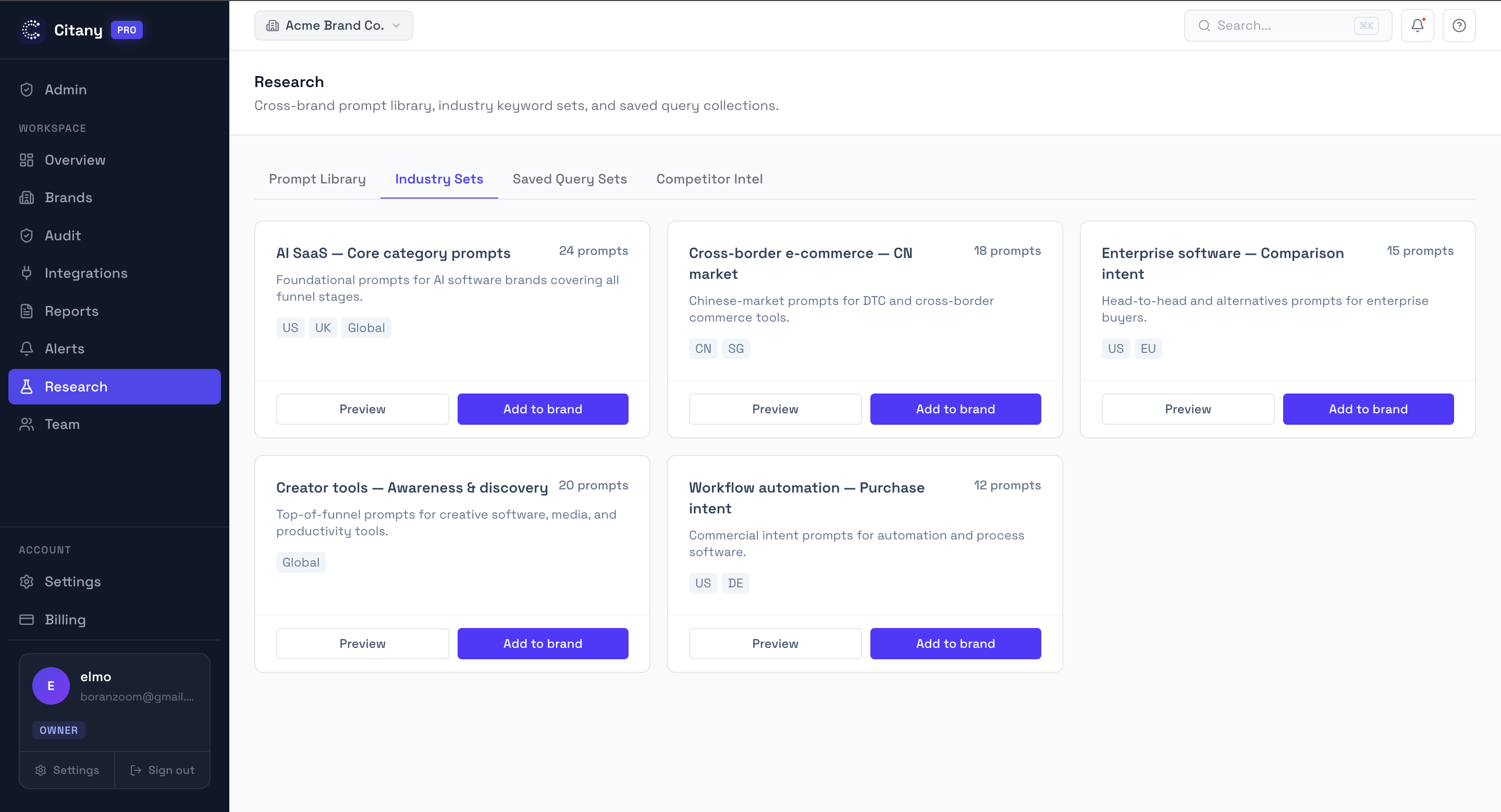
Build market-aware prompt libraries that reflect how people ask AI about tools, products, alternatives, and recommendations across global mainstream and localized search ecosystems.
The real problem prompt research solves
AI visibility is only as useful as the prompt set behind it. If the team only checks branded questions, it never sees the moments where people are researching the category, comparing options, or hearing competitor names first.
Most companies also mix educational prompts, buying-intent prompts, and edge-case risk prompts into one unstructured list. That makes monitoring noisy and turns reporting into a debate about sample quality rather than a conversation about what to do next.
Signals that your current prompt set is weak
- You keep seeing your brand on branded prompts but lose on non-branded category prompts.
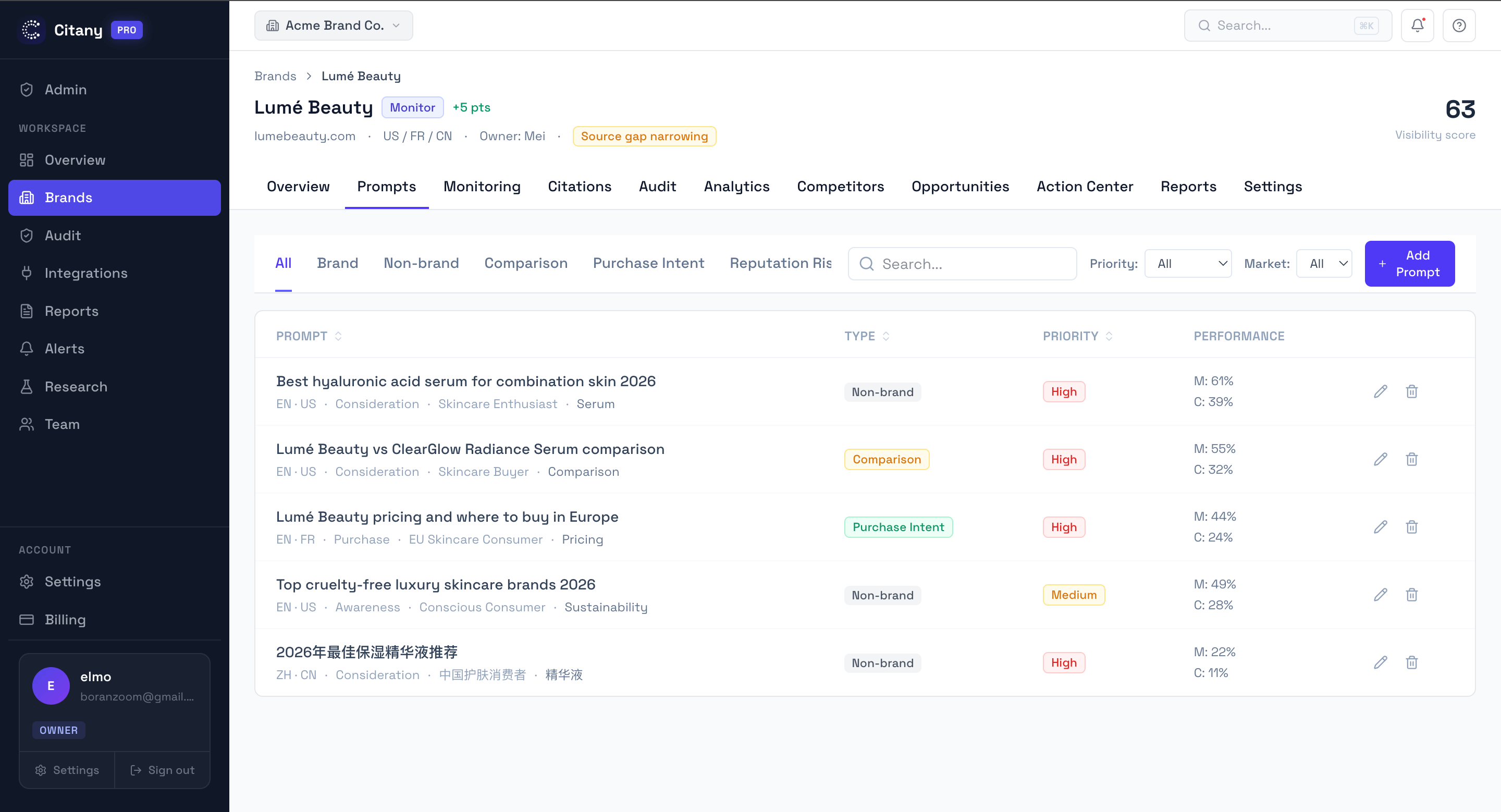
- The same prompt is phrased differently by English and Chinese users, but the team tracks only one version.
- Different departments ask different questions and no one agrees which prompts should be reviewed every month.
- Your reports explain what happened but not which prompts actually matter for discovery, comparison, and conversion.
What the module organizes
Category and discovery prompts
Track the questions people ask when they are still deciding what type of solution, product, or brand they even need.
Comparison and alternative prompts
Separate high-intent prompts such as best tools, alternatives, or category leaders from general educational questions.
Market and language variations
Track how the same buying intent is phrased differently across global and localized search ecosystems.
Repeatable reporting sets
Save prompt groups so benchmarks, monthly reporting, and experiments all use the same measurement frame.
How teams should use the output
The point of prompt research is not to create a giant list for its own sake. It is to decide which prompt clusters deserve monitoring, which gaps matter most, and which pages or narratives need to be strengthened first.
A good prompt map also makes the rest of the workflow better. Monitoring becomes cleaner, competitor analysis becomes more honest, and reporting becomes easier to explain because the team is looking at demand the market actually has.
What to expect in the first month
- A cleaner split between branded, non-branded, comparison, and risk prompts.
- A better understanding of where your brand is absent during real discovery moments.
- A shared prompt library the team can reuse across audits, reporting, and experiments.
- A clearer view of which prompts deserve content, comparison, FAQ, or PR work first.
Frequently asked questions
Common questions about this workflow, use case, or research area.
What kinds of prompts should we include first?
Start with non-branded category prompts, comparison prompts, and the bottom-funnel questions that decide who gets recommended. Those are the highest-value gaps for visibility.
How many prompts do we need before the data becomes useful?
You do not need hundreds on day one. A focused set across category, comparison, problem-solution, and risk prompts is usually enough to surface the first serious blind spots.
Should we track the same prompt in both English and Chinese?
Not literally. The intent should match, but the phrasing usually needs to reflect how each market actually asks the question.
Related pages
Explore the next-most relevant product, solution, or research page.
Next Step
Check your own brand against these patterns
If this page matches what you are seeing, run a free audit to review prompt coverage, competitor gaps, and the sources shaping AI answers in your category.